
Pharmacy faculty members Drs. Mark Chirico and Eric Hobson recently were invited to join the Nonprescription Medication Academy via attendance at its annual meeting in Cincinnati, Ohio. Dr. Hobson provided the meeting’s Keynote session, “Pharmacy students’ learning styles: course and curricular implications,” and Closing session, “Developing and using rubrics to enhance student learning … and faculty satisfaction.” Dr. Chirico presented his poster presentation, “Group learning method for teaching Rx to OTC switch to first-year students.”
PT Students Pitch In for Dierks Bentley’s Miles & Music for Kids
Professor Mike Voight reports. . . .

During the October celebration of national physical therapy month, approximately 100 Belmont University Physical Therapy students and faculty volunteered their time to assist with the organization and on-site operation for the 4th annual “Dierks Bentley Miles & Music for Kids” charity motorcycle ride and concert to benefit Vanderbilt’s Children Hospital. The ride took place on October 11th when thousands of leather-wearing folks gathered on their ‘hogs’ to ride along-side Dierks Bentley for his annual Miles and Music for Kids. Starting off at the Cool Springs Harley Davidson in Franklin, TN; the ride wound its way through the Natchez Trace down to Riverfront Park downtown Nashville. There, Dierks was joined by some his best celebrity buds to entertain the masses … literally THOUSANDS of people all to raise money for Vanderbilt Children’s Hospital.
OT Professor Contributes Chapter to New Book
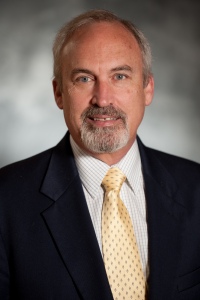 Dr. Scott McPhee, Professor of Occupational Therapy, had a chapter recently published in the book, What you need to know about Nursing and Health Care in the United States (B.L. Nichols & C.R. Davis, Eds., New York: Springer Publishing). This book is intended for foreign trained nurses who are applying for a visa to work in the United States.
The chapter Dr. McPhee wrote details the history of occupational therapy, education requirements, licensure, and areas of practice (with descriptions of typical types of patients and goals for therapy).
Pharmacy Students Receive Immunization Certification
The School of Pharmacy’s Class of 2012 recently received Immunization Certification, following completion of the American Pharmacist Association Pharmacist Immunization Training Program. This achievement is not only good news for the students and the School of Pharmacy, it has important implications for Belmont University, the Nashville community and all of the communities from which these students come. These 68 students will now join six pharmacy faculty to provide 74 additional health care providers who are able to provide immunizations when needed.
PT Graduate Chosen as Outstanding Young Alumna from APSU
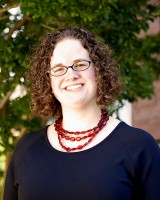 Dr. Bethany McKinney Froboese, a 2003 graduate of Belmont’s School of Physical Therapy, has been chosen as an Outstanding Young Alumna by her undergraduate alma mater, Austin Peay State University. The award recognizes her contribution to APSU as a volunteer. Froboese will be honored with other alumni award recipients during homecoming festivities at the end of October.
After receiving her Doctor of Physical Therapy from Belmont, Froboese took a job as a physical therapist with Inmotion Rehabilitation. Three year later, she joined Premier Medical Group and, in 2007, she found her current position as a physical therapist with Tennessee Orthopeadic Alliance.
Froboese is a member of the American Physical Therapy Association and the Tennessee Physical Therapy Association and is a Susan G. Komen lymphedema treatment provider. She is a certified Lymphedema therapist, a certified clinical instructor and a certified sole supports provider.
Her volunteer work also extends into her community, such as assisting in a one-day teaching experience for Clarksville-Montgomery County School System anatomy and physiology AP classes about physical therapy and physiological principles used for her profession.
Those Nurses
Dr. Ruby Dunlap’s Ugunda Fulbright Blog
 Along the stone retaining wall outside our apartment is a row of snowy white daylilies. That is, I call them daylilies because of their leaf, stem and bud shapes. If not actually a daylily, they must be close kin to the daylily tribe. The flowers start out as a daylily bloom, a suggestion of a white trumpet on a slender stalk. But then the Designer of this flower changed His mind. Instead of the expected trumpet shape, the flower turns into a loose fringe of white, the petals going abruptly from wide to narrow in a graceful drape. I do not know which gives me more pleasure, the recognition of a familiar plant type or an unexpected variation in that type. This daylily illustrates my conviction that our appreciation of diversity needs to be anchored in an appreciation of unity. Otherwise, diversity becomes mere difference and mere difference seems to me to degenerate easily into competitive hostility among differences.
Pharmacy Student Receives RXportfolio National Achievement Award
Zachary Renfro, a second year student in the School of Pharmacy at Belmont, was one of 20 students selected nationwide from more than 9,000 entries as a recipient of the 2009 RXportfolio National Achievement Award. The award criteria consisted of content, quality of writing and overall achievements professionally displayed within their RXportfolio.
Gov. Bredesen, U.S. Rep. Cooper Lead Healthcare Conversation at Belmont
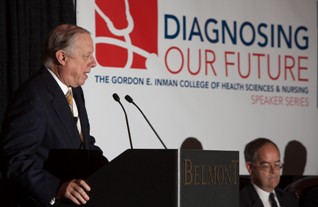 Tennessee Governor Phil Bredesen and U.S. Representative Jim Cooper provided the keynote addresses for “Diagnosing Our Future,” the inaugural presentation in Belmont University’s Gordon E. Inman College of Health Science & Nursing Speaker Series. The event was held on October 13 in the Frist Lecture Hall in the Inman Center on Belmont University’s campus.
The theme of the speaker series, “Diagnosing Our Future,” reflects the call to collaboratively advance new ideas to improve healthcare and healthy living for future generations. The purpose of the series is to connect these ideas with the greater community of Nashville and Middle Tennessee and with students in Belmont’s health science programs who are preparing to serve society as physical therapists, pharmacists, registered nurses, nurse practitioners, occupational therapists, and social workers.
Nursing Professor Recognized as a Health Care Hero
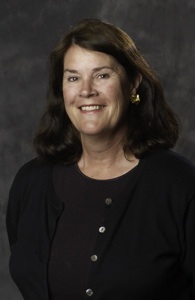 The Nashville Business Journal recently honored professor Jane Shelby as one of the 2009 Health Care Heroes in Middle Tennessee. Shelby is a professor of nursing and the former director of the university’s undergraduate nursing program.
“I am very honored and humbled by this award,” said Shelby. “It really is not an award for me personally but for all the faculty and staff in the School of Nursing who work so hard to prepare our students for their profession.”
Shelby was recognized in the “Behind the Scenes” category along with other local leaders, including Aileen Katcher of Katcher, Vaughn and Bailey Public Relations, Julie Warner from the Matthew Walker Comprehensive Health Center and Jonathan Uttz from Psychiatric Solutions. This was the third annual luncheon to “help celebrate the accomplishments of the leaders, innovators, strategists and caretakers, whose work is helping to grow the region’s health care industry and reinforcing Nashville as the health care capital of the nation.”
Pharmacy School Holds First Annual Practice-Site Poster Forum
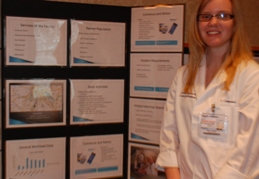 Second year Student Pharmacists who have completed their first practice experience rotations recently presented posters summarizing their experience in the Frist Lecture Hall. Fifty-six posters in all were displayed showing unique characteristics of the practice sites and the learnings achieved at these sites. First year pharmacy students, who will begin their practice rotations in January, attended to get tips on site selection, and pharmacy faculty attended to learn about student involvement at the sites.
According to Dr. Mark Chirico, assistant professor of pharmacy practice, who is course coordinator for the P-2 practice experiences, “This forum presented a unique learning opportunity for all participants. It exemplified the practical nature of our program and the hard work our student pharmacists are putting into their education.” The School of Pharmacy has more than 100 sites for training student pharmacists in dispensing and patient care across greater Nashville, and the number of sites is growing every semester to accommodate the growing student body.
Belmont Board Member R. Clayton McWhorter receives award for service
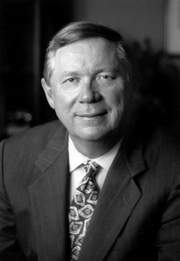 R. Clayton McWhorter has been named the recipient of the Community Foundation of Middle Tennessee’s 16th annual Joe Kraft Humanitarian Award. McWhorter, a businessman and former health-care professional, serves as chairman of the board for PharmMD, and he is on the board of trustees for Belmont University.
Belmont Grad appointed to Kansas Occupational Therapy Council
Kansas Governor Mark Parkinson has appointed Angela Petite to that state’s Occupational Therapy Council. Petite, of Leavenworth, Kansas is an occupational therapist for USD 409, Atchison Public Schools, providing assessments and services to children identified with special needs. She attained a master’s degree in occupational therapy from Belmont University and her certification in 2004. The Occupational Therapy Council reviews all applicants for examination and licensure, determines the applicants who successfully pass the examination, licenses applicants and adopts rules and regulations as necessary.
The Maid Escaped Mid-Term
Dr. Ruby Dunlap’s Uganda Fulbright Blog
 As Dad and I walk down to the track most mornings around 6:30 AM for exercise, we meet many elementary school children in neat uniforms headed for school. They walk purposefully and soberly but their faces break out into smiles as we greet them. “Good morning,” Dad says, “God bless you. God loves you. Have a good day at school.” And they beam with pleasure, receiving the gift as Dad intended to give it.
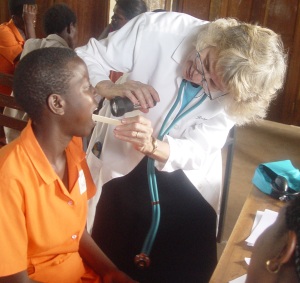
We see children outside the campus headed for school in deep purple, bright pink, yellow, orange or green uniforms. The effect is of a moving flower garden. The imagination fast-forwards 5 years, 10 years, and one wonders what kind of man or woman each child will be father or mother of and what kind of world today’s fathers and mothers will leave tomorrow’s. I especially wondered this as I spent a day this week doing school physicals on 43 girls ages 13 to 20 at a secondary boarding school.
Madame Janet visits Mityana
Dr. Ruby Dunlap’s Uganda Fulbright Blog
Uganda’s premier English language newspaper, The New Vision, had this article with the headline, “MEDICAL STAFF ABANDON HOSPITAL IN MITYANA” in the 23 September issue, page 7.
Over 40 medical workers in Mityana Hospital on Monday morning abandoned work, leaving 400 patients unattended to.
The workers went to attend a court session where their four colleagues were charged with manslaughter following the death of a pregnant woman in labor.
Sources in the hospital said workers reportedly agreed not to return to work unless their colleagues were granted bail.
Nurses Jane Nanfuka, Agnes Namirembe, Joy Namutebi and Dorris Nalwanga allegedly refused to attend to Sylvia Nalubowa and her unborn baby last month.
The hospital administrator, Charles Luzira, said the medical workers were not on strike but were only showing solidarity to their colleagues and would return to the hospital after the court session.
The nurses were backed by officials from the national midwives and nurses association.
Chief magistrate Justine Atukwasa granted the accused bail of sh200,000 each which they paid. She then ordered them to return to court on October 6.
I say “Mattress,” you say “Matt-er-ess.”
Dr. Ruby Dunlap’s Uganda Fulbright Blog
 “Does the U.S. have a big problem with culture?” asked Eva, her small face full of concern. We had just finished reading and discussing Wellman’s chapter on “The Diverse Learning Needs of Students” in the 2009 Billings’ textbook on Teaching in Nursing. The “problem” in this chapter (pp. 21-22) is expressed partly as a catalogue of failures, failure to recruit sufficient minority nursing students and nursing faculty, failure to adequately support the minority student, etc. “Well, children in the U.S. go to similar schools,” I said, “and almost all of us speak the same language. We do have some cultural issues but I don’t think we have a ‘big problem’ with culture. What about Uganda?”
“Oh, all children in Uganda learn English from the beginning,” she said, taking her cue from me. “We don’t have a big problem with culture in Uganda.” (See photo of Eva, the young woman wearing the black sweater. Christine is busy at the computer in front of Eva who is speaking with Keren.)
“When were you last de-wormed?”
Dr. Ruby Dunlap’s Uganda Fulbright Blog
While in Kampala on Saturday, I received a frantic text message from Bob: “Come home and look at my stomach.” He was indeed in a pitiable state with an intensely itching rash and welts erupting all over him within a few hours. He was having an obvious allergic reaction to something. We thought at first it might be the laundry detergent. Perhaps Amina hadn’t rinsed his clothing sufficiently? I gave him what I had: topical diphenhydramine and also topical cortisone I had purchased at a Mukono pharmacy on the way home. I also had him take Advil PM which has close to 40 mg of diphenhydramine per tablet. That made him sleep and calmed the itching for a little while. But the rash kept growing and I began to get suspicious of the doxycycline. Antibiotics are notorious for causing rashes like the one Bob was having. I instructed him not to take any more doxy and re-washed all of his clothing, rinsing everything until the water was perfectly clear.
This Week in Kampala
Dr. Ruby Dunlap’s Uganda Fulbright Blog
Kampala is a city of unknown millions who, from a distance and from a height, has a lush look to it with many red tiled roofs nestled among trees and rolling hills. Marabou storks are its biggest birds, tall, gaunt, bald-headed carnivorous birds that prefer their meat well-aged. When one sees many of them circling, a ballet of exquisite grace for one of the world’s ugliest birds, one can be sure of a butcher shop close by.
Getting into Kampala from Mukono is a laborious drive of around an hour if one is lucky, the vehicle lurching either to avoid or try to beat other occupants of the road to a coveted spot. Lurching, I might add, in a mix of oily black diesel fumes, red Ugandan dust, and the smell of garbage which litters the roadsides. I had to make this trip four times this week. I have decided the experience gives me sensory data with which the better to enter imaginatively into Dante’s Inferno.
The first trip was on Monday for groceries, a weekly hire of driver and vehicle which has become necessarily routine. The next two trips were for a two day meeting of a Duke University sponsored “partnership to improve the Ugandan health system.” Mike Smith, the chair of health sciences at UCU, had been invited and, in turn, invited Jean Chamberlain, a Canadian OB/GYN who has made it her personal life’s mission to reduce maternal mortality in Uganda, and Edward, the Ugandan physician who heads an undergraduate program in health administration which is funded by another Canadian organization. As it turned out, I was the only nurse invited to the group.
First Class Maps
Dr. Ruby Dunlap’s Uganda Fulbright Blog
“Africans don’t like maps and they don’t use maps,” laughed my Ugandan colleague as he handed Mike Smith’s map to me. Mike wanted me to see the turns in the road, the towns and villages, and the geographical features of the country through which we were traveling from west to east as we headed to Sipi Falls.
“What do you do when you want to get somewhere?” I asked. “Do you just start out in the general direction?” But they laughed as though my question were hardly worth answering. Even without maps, Ugandans are a people on the move and they always seem to end up where they want to be. Ben, our Saturday afternoon speaker for the retreat, told us the chilling story of how Idi Amin had punched him in the face, causing the loss of his eye, and how he had followed the railroad track by foot to escape being murdered by Amin’s henchmen. It took him nine days to walk from Kampala to the Kenyan border to safety, the railroad mapping his path securely.
Ben, at the time the editor of one of Uganda’s English language newspapers, hadn’t caught a typographical error in the headlines. The headline was supposed to read, “Amin Raps Nyerere” or some such other African leader. Someone had inadvertently put an “e” after the “p” in “Raps” and Ben had not caught it before it went to press. Amin was not amused. “Ben is one of the few important people who survived the Amin years,” one of the Ugandans told me later.
Sipi Falls Retreat
Dr. Ruby Dunlap’s Uganda Fulbright Blog
 Members who could from UCU’s health sciences department spent the weekend in a retreat at Sipi Falls near the Kenya border. That I survived this experience is testament to a God in heaven. It all began innocently enough with Faith, one of those splendidly capable young women such as Belmont’s school of nursing has in Karen and Heather, telling me “we would do a little walking.” Faith had organized the whole thing, all the meals and the stay at the Crow’s Nest at Sipi Falls. Why that name didn’t make me suspicious I’ll never know.
We loaded up on the school of nursing bus: department head, physician Mike Smith who, besides myself, was the only other expatriate. Faith, Maureen, and Dorothy, department administrative coordinators. Jemimah, the chair of nursing.
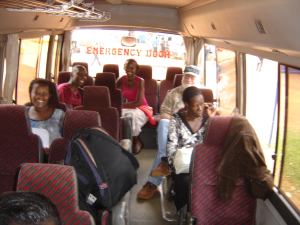 Edward, a physician, who is the administrator of a MBA in healthcare. Francis, one of the instructors for their BS in community health, an important non-nursing health profession in developing countries. Clarissa and Selah (pronounced Sell-ah) from the MPH in maternal-infant health. Mike told me it’s actually an MPHL (MPHLeader) degree, open to anyone with a previous bachelor’s degree and very popular; it has UCU’s largest enrollment for a health profession. Tom was our driver. And finally, Grace and the other Faith, two of my MNS students and also faculty for the RN-BNS program. Here’s a photo of our first meal stop, lunch on Friday. I had beans and rice with greens, all delicious.
Finding a Rhythm
Dr. Ruby Dunlap’s Uganda Fulbright Blog
Had it been a philosophical chicken, it certainly would have appreciated Thomas Hobbes and his cynical view of things. From the moment it emerged from its shell, wet and tottering, until it was finally dispatched by someone to be eaten by me and mine, it had lived to eat brutishly and avoid being eaten nastily.
It had been marginally successful in its first ambition and finally unsuccessful in its last. Now, to add insult to injury, I was critically gazing at its scrawny, blue-tinged carcass and wondering why I had paid 12,000 Ugandan shillings for it, roughly about 6 USD.
Chicken, I had been told, is more expensive than beef in Uganda. My experience has validated that. A plump fryer-sized chicken in a Kampala grocery store costs about 16,000 shillings or 8 USD. A pound-sized package of minced (ground) lean beef costs about 1.50 USD. The chicken in my kitchen had been purchased, sight unseen, from someone Karen had said raised really extra good chickens. This must have been one of their bad-chicken days.
Gail Bursch review of new book by Jill Bolte Taylor
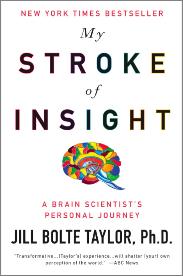
Book Review of My Stroke of Insight by Jill Bolte Taylor, PhD
published in The Art of Teaching
reviewed by Gail Bursch, Belmont University School of Physical Therapy
In the midst of beginning another hectic school year, take a deep breath and a moment to imagine the consequences of suddenly having a stroke or traumatic brain injury. Consider the misfortune of a successful neuroscientist, who taught Harvard medical students and conducted research at the Brain Bank, having a massive stroke at the age of 37. After surviving a massive bleed in the left hemisphere of her brain, Dr. Jill Taylor wondered if she would be able to speak again, to walk again and would they take her PhD away?
The ways in which Jill connected with the outside world for help during the four hours her brain was hemorrhaging is an amazing story. Because the left hemisphere contains the speech and language centers, she could not speak intelligibly nor recognize phone numbers. Each normal function shut down one by one as the bleed progressed. The curious neuroscientist in her monitored the details; overcoming the fear and desire to succumb to a peaceful death. Jill described the loss of her ‘brain chatter’, which refers to the left brain monitoring time and details, categorizing everything so that we can make sense of the world. With the left brain injured, her right brain became dominant resulting in silent euphoria and feeling at one with the universe.
Karen and Jemimah
Dr. Ruby Dunlap’s Uganda Fulbright Blog
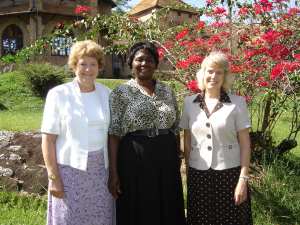 Karen Drake is a tall, strong woman whose primary home is now Minneapolis but who has spent most of her life on foreign missions of one kind or another. She lived with her parents in Japan until she was 17 years old, becoming fluent in all things Japanese.
Justice
Dr. Ruby Dunlap’s Uganda Fulbright Blog
“Do not,” warned Ben, the security specialist at the U.S. embassy, “go toward a crowd of people. Move away as quickly as you can when a crowd starts to gather.” Uganda is among those countries distinguished by regular occurrences of mob justice within its borders.
A couple of U.S. college students in their study abroad semester at Uganda Christian University, perhaps motivated by curiosity mixed with the natural tendency to behave in ways opposite from what one has been told, went towards a crowd instead of away from it and witnessed the beating to death of a man by a mob.
The day after we arrived, the local paper had a story about a landlord who was first hacked and then burned to death by irate tenants who had heard he was thinking of selling his property. It happens here regularly enough, “mob justice,” a category of justice within this society. Litigation is rare among those Ugandans who have cheaper and more effective ways of retribution at their disposal.
Taking Care of Business
Dr. Ruby Dunlap’s Uganda Fulbright Blog
The circulatory system of Kampala is an atherosclerotic mesh of streets most of which wind through the vast slums which, if reports are correct, characterize the cities of the so-called developing parts of this planet. There are sections of privileged residences and businesses behind fortresses of thickly spiked walls, gates and hired guards.
The U.S. embassy is one of these, a massive structure of multiple barriers and checks. Our embassy driver had never left his vehicle but hired nationals guarding the entrance still lifted the hood and ran a mirror underneath it to check for any discourtesies before allowing it to proceed through yet more checks and barriers when we arrived at the embassy around 9 am Wednesday morning.
We walked through a metal detector. I had to leave my three memory sticks and calculator at a front desk; no electronic devices of any kind are allowed to be carried into the embassy. After that, we had to leave our passports with a young Marine who sat behind thick glass at the final check. We were met by Dorothy, the Ugandan national who works as a cultural affairs attaché and who had facilitated the orientation for the Ugandan Fulbrighters in Washington in June.
Congressman Cooper’s Chief of Staff visits College
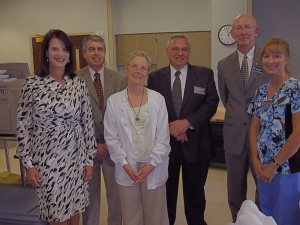 Lisa Quigley, Chief of Staff for Congressman Jim Cooper, recently visited the College. Pictured here from left to right are Ms. Quigley; Christopher Coates, President & CEO of American Seniors Foundation; Beth Williams, Simulation Assistant; Jack Williams, Dean of the College; Phil Johnston, Dean of the School of Pharmacy; and Joy Cook, Adjunct Professor of Nursing.