Mission to Cambodia: Siem Reap to Phenom Penh
Today we traveled from Siem Reap back to Phenom Penh. Our time in Siem Reap on Friday night and Saturday was a relaxing break from the busy three days at clinic. On Sunday morning, we ate breakfast at the hotel and then all loaded onto our bus for the trip back to our Cambodian home, the Golden Gate Hotel. We started our bus ride with a devotion, as we do most days. Dr. Taplin quoted Mother Teresa about giving ourselves and our time to individuals and organizations rather than just giving only money – although both are so important! This was impactful because it related to our trip in that we have been giving our time and our hearts to the people of Cambodia, even if we sometimes feel that our efforts aren’t making much of a difference.
Many of us, including myself have struggled with feeling we aren’t making an impact. With the vast amount of help we can’t provide and the presence of bad, it can be difficult to reframe how we view things, and focus on the good. The positive we have experienced is that in only three days, we were able to work together to serve over two hundred people at clinics. That was hopefully impactful for each of the people who were able to come and was all due to God. His hand was evident in partnering with organizations here and bringing people to the clinics. On the other hand, I feel as if we aren’t able to do a lot for many of these people. Many come dehydrated. While we provide oral rehydration solution and teaching about clean water, the fact remains that clean water can be difficult to come by. Our translators are incredible, but it can still be difficult to communicate medication and teaching, so at that point we simply have to trust that God is in control. All this to say, this devotion was encouraging that we were making a difference – however big or small – on the people we interact with daily.
Since it was Sunday, we worshipped together after the devotion. We began with a song led by Dr. Taplin and then continued to worship for another hour. It was a really meaningful time for many of us, even though it wasn’t your traditional worship service. We just sang with our voices as we drove through the small provinces and looked out the windows, which was a unique experience. After a time of seeing much heartache and little time to process, this was an encouraging time to be reminded that God is in control and has His hand on each of the people of Cambodia.
Daily we do highs and lows, which is a really growing aspect of our group. Even though we spend the majority of each day together, we each have different experiences and perspectives. Since the last few days had been busy, we hadn’t had an opportunity to gather and share. Hearing about everyone’s experiences with our last clinic, visit to the temple, and all the in between moments was so insightful. By the time we had finished our devotion, worship, and highs and lows, it was already time to stop for lunch! After a long lunch – serving twenty people always seems to take a bit of time – we were back on the road.
A few hours later, we stopped at a market from the recommendation of our bus driver. As you can see from the pictures, it wasn’t your traditional market and had assorted bugs. Four of us brave souls ate a fried tarantula. This moment was one we had both looked forward to and dreaded for months coming up to the trip. Some also enjoyed fried crickets and rice filled bamboo. Others stuck to the comfort and coolness of ice cream. Each experience has been unique, and this market was no exception! The delicious treats aside, we were back on the road! We arrived back in Phenom Penh and had a relatively uneventful evening back at the Golden Gate. We enjoyed being welcomed back by Heim and the fellow staff and had dinner at the Blue Pumpkin. We feel rested from the weekend and are ready for this next week in Phenom Penh – the last for many of us!


Mission to Cambodia: First Day Back in Phnom Penh!
Today was a much needed recuperation day for us undergrads! We’re all so thankful to be back in Phnom Penh, because it’s really started to feel like home.
We began the morning with our familiar breakfast here at the Golden Gate Hotel (lots of mangoes for me!) and then had our daily devotional. We then broke into our individual pairs and prepped some for our teaching day later this week. We have the opportunity to teach some students at the hospitals, so we whipped our power points into shape and went over what we would say and do with our students. We had some free time this afternoon (a rare and beautiful thing) so a couple of us went to a local coffee shop to catch up on neglected school work. The shop we went to felt very much like home: modern, air-conditioned, and with good wifi. It’s cool to think about those shared experiences we have with the students here of going to trendy coffee shops to desperately try to study or write an assignment. It was also a huge relief to feel like I’m caught up with school and not let it distract me from all the amazing things we’re doing here.
For lunch we ate at one of our favorite restaurants! It’s a favorite mostly because they serve amazing western food, including milkshakes. I know I left happy, and it looked like the rest of the table was pleased with their meals too. It’s hard to dine with so many people sometimes because Cambodians just bring out the food whenever it’s done, so by the time the last person gets their food half the table is usually finished. This bothered me a little when we first arrived because it felt rude to not wait for everyone but I think we’ve all learned that if we waited everything would get cold. It’s a small difference between here and the US, but it’s really noticeable with a group of 20 dining at a small establishment.
The afternoon was free for us as well, so a group of us went to the central market! We’ve been to several markets before but I think this one was by far the largest. It was open air, though, and partially indoors in a spacious building, so it didn’t feel as suffocating as the Russian market feels. I proudly walked out without spending a penny, but several of us left with multiple sey, a small toy that you use to play a game similar to hacky sack. It’s our favorite game to play down in the lobby during the evenings, so I expect quite a few of you family members and friends will be introduced to it when we all get home. After the market, a large group decided to make their way back to a coffee shop to work. I, feeling that I had accomplished enough that morning, made the executive decision to take a nap instead. It was very much needed after our long days of travel and temples and clinics.
Dinner was another lovely meal at our most frequent stop, Anise. They have such a good variety, so everyone leaves with something they liked. I know a few of us were feeling a little ill, but the group stayed positive and we had a great dinner regardless. There was plenty of lime soda all around!
To top off a very good day, a few of us played sey before heading off for a massage. This was my first massage experience here in Cambodia, and while it was fun I don’t think I’ll be joining the ranks of the massage enthusiasts. I am far too ticklish to have a stranger touch my feet, but I’m glad I finally experienced what all the hype was about! It was a peaceful way to wind down and de-stress a little on an absolute whirlwind of a trip.
Mission to Cambodia: Third Clinic in Poipet and Traveling to Siem Reap
My roommate and I woke up this morning convinced that the world was ending. Music and yelling from the streets outside our hotel was so loud that we could feel the entire building shaking. Turns out it was just a parade because of the upcoming election that was casually going on at 6:20 AM. Cambodians are early risers, that’s for sure. Once we were assured that the world would in fact go on, we got up and got ready for the day. After a breakfast of noodle soup and iced coffee with sweet milk, we were off to our third clinic around Poipet.
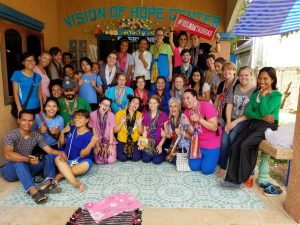
On the bus in the morning, Dr. Massie led a devotional and prayer. She spoke about how we are all broken in our own ways, but that God uses our brokenness and our differences for the good of his Kingdom if we come to Him as we are and allow Him to work through us. If you are interested in the story that she shared with us this morning, google “Indian cracked pot story”. Unfortunately, the parades for the election caused a lot of traffic buildup and we were a bit late showing up to the Vision of Hope Center, a small Christian school that opened its doors for us to set up our clinic. Our lovely translators and other friends from Freedom’s Promise met us there. The building was small but we made it work as usual. Today was a short day due to both showing up later than planned and also because we had a three-hour bus ride from Poipet to Siem Reap, where we will be staying until Sunday morning. Despite only lasting a little over three hours, we were able to see a good number of patients. The nursing students switched roles a little bit so that we were all able to have multiple experiences over the three days. Kim and Paige soldiered on assessing and diagnosing, and the pharmacy team did an amazing job working together and working with what they had to provide the best care that we could for these people.

Last clinic in Poipet with all of the wonderful missionaries and translators who partnered with us to make these clinics possible!
I had the opportunity to be at the education and prayer station, which was the last table that the patients would go to before leaving. This was a difficult but really great experience for me both as a nursing students and as a Christian. A huge part of nursing is patient education, but I have not had many opportunities in nursing school so far to put that into practice. I found myself drawing from things I have learned in nursing school so far and being so thankful to Belmont and the wonderful education that I am so blessed to receive there. I spoke to patients about things like how and why to take the medications that they were given, different diet and lifestyle changes for things like diabetes or hypertension, living with asthma, relaxation techniques for anxiety, proper hydration and nutrition, and more. My heart went out to each individual that I spoke with, especially when it was clear that they were in need of the kind of medical care or

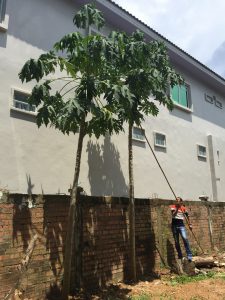
Getting fruit off the trees outside the school
education that we simply could not provide them with. After asking if they had any more questions, I would ask if it was okay if I prayed for them. Almost all of them said yes, and this was a special time to call on the Lord and ask for healing and safety for these people who we have grown to love so dearly in our short time here. Many of the people who I prayed over today were most likely Buddhists, but I was amazed at their reverence while praying and the kindness that they showed to me during our brief but hopefully meaningful interactions.
Around 1 PM, we packed everything up and ate a lunch of peanut butter sandwiches and some delicious fresh mango from right off the trees outside the school. The translators and everyone from Freedom’s Promise showed us so much love and kindness during our three days here, and they gave each of us a gift of a beautiful Cambodian scarf. After a prayer, lots of photos and hugs goodbye, our group of 20 piled into our bus and headed to SIem Reap.

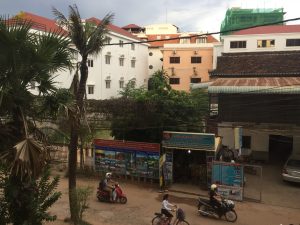
Views from our hotel in Siem Reap
The bus ride was about three hours long and the other undergraduate nursing students and I we passed the time telling gross and funny stories from our experiences in nursing school. We were stuck in traffic once again in Siem Reap because of the election. Once we arrived to the hotel we were greeted with cool towels and tea. We ate dinner at a rooftop restaurant on the top floor of our hotel. The hotel here in Siem Reap is very nice and we are all so excited to have a break from working hard in the clinics and for the opportunity to tour the temples around Siem Reap tomorrow! Everyone is going to bed early because tomorrow we leave at 4 AM to catch the sunrise at Angkor Wat!

Mission to Cambodia: Second Poipet Clinic Day

One of our translators Sarah!
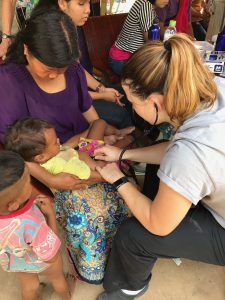
Today, we held our second day of clinics in Poipet. We started off the day with leftover, cold pizza for breakfast because we needed a pick me up from yesterday’s breakfast. Our group had ventured out and we were served Khmer porridge with chicken liver and some were adventurous than others. A woman from the community opened up her home so we could use it as the clinic. It was a smaller space with an open patio and curtains to block out the sun (we greatly appericiated this). It was amazing this woman who didn’t know us would offer up her home so we could run the clinic in her village. We didn’t know where we were going to set up clinic, but we trusted God would provide and He did. We saw around 70 people that day of varying ages. We saw several babies and children and it was sad to see what they were going through, especially the malnourished children and scabies wounds.

One of our practitioners, Kim, assessing this sweet baby!
This is such a huge problem in all third world countries, but it never gets easier to see children suffering from it. The children are still so joyful and want you to play with them despite them not feeling their best, which is very inspiring. Our translators from Freedom’s Promise were outstanding. There was no way we could do our job without them! We all worked with the same translator for the 3 days of clinics so we got to know them really well and enjoyed spending time with them.
From the outside looking into the clinic, it looked like mass, unorganized, chaos, but on the inside everyone had a place and job. We had nurse practitioners, undergrad nursing, and pharmacy all working together to make the clinic run smoothly. We functioned extremely

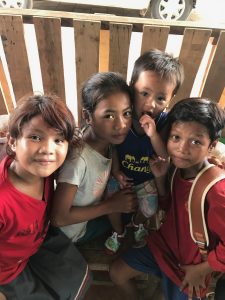
Some of the sweet children we were able to take care of
well together, especially since it was our second day understanding how the flow of the clinic should be. The most incredible part of the day was watching our entire team work together and really see all of the nursing & pharmacy skills we have learned put into practice. It was like it finally clicked with us how much we truly knew and have learned. This was a neat experience because we all had different moments when we realized this. Several of us shared stories that night during our highs and lows about those moments. Highs and lows are something we do (attempt) every night where we can share moments or stories from the day with the whole group. Even though we were together all day, we all had different experiences and enjoy hearing our different views. IMG_7055.MOV (click on link to see video)
Later tonight, we went to dinner and then came back for praise and worship with Freedom’s Promise. We sang and worshiped together and it was truly amazing to see just how powerful God’s love is. His love is not just in our Bible belt of the South, but across the entire world. It is very powerful to watch Him work in everyone’s lives and see how much impact God has had in Cambodia and in our lives the short time we’ve been in Cambodia. After we worshiped, Freedom’s Promise brought out handmade bags, wallets, and other little items for purchasing. Our group swarmed at them because apparently we can’t pass up a good Cambodian deal. Dr. Massie was the first one there and just about everyone in our group bought something! We had a great day and tomorrow we are doing another clinic in Poipet before we head to Siem Rep for temples and being tourists!
CHS Faculty and Staff Perform to Raise Money for Charity
Dr. Natalie Michaels, associate professor in the College of Health Sciences and Michal Christian, program assistant in the School of Nursing, continue to make music together in an effort to raise money for the Down Syndrome Association of Middle Tennessee. With the addition of Dr. Mark Christian, adjunct professor in the College of Theology and Christian Ministry, the group played everything from “Misty” to “I Will Always Love You.”
Michaels has been singing and writing music since she was 10 years old. She also plays piano and the flute. Michal Christian is a classically trained ballet dancer and musician, and Dr. Mark Christian is a professional guitarist.
PT Students Recognized for Community Service
Each year, doctoral students from the School of Physical Therapy participate in various community service activities, which include partnering with local organizations to build ramps for those in need. During the spring semester, Belmont PT students marked a milestone by helping the United Cerebral Palsy of Middle Tennessee (UCP) and Tennessee Housing Development Agency (THDA) with construction of the 2500th Wheelchair Ramp build in the state-wide collaborative Wheelchair Ramp Program. The efforts were recognized in local media outlets WSMV and Nashville Community Newspapers. You can read the stories by clicking on the links above.
Mission to Cambodia: On the way to Poipet we go!
After nine hours of riding in a bus that reminded me of the Taj Mahal (purple curtains included), our entire team has finally arrived in Poipet, Cambodia. The bus ride started out a little rough. Unfortunately, the fire extinguisher fell from one of the overhead shelves and exploded as soon as it hit the ground. The white fumes started spreading everywhere, so we quickly pulled over to air the bus out. After that little hiccup, we were smooth sailing. And by that I mean the bus ride felt much like a wooden roller coaster at an amusement park.

When the fire extinguisher broke – note the purple curtains and seat covers.

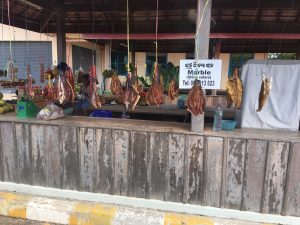
Meat market at one of our stops

After arriving in Poipet, we checked in to our hotel and headed straight to dinner. We were all starving and in desperate need of some nourishment. One of our hosts took us to a casino on the Thailand border and we ate at the restaurant inside. For the past week, I’ve been on a hunt to find something green to eat (coming from the girl who eats spinach out of the bag like chips). Lucky for me, the restaurant had broccoli! I was on cloud nine to put something green and tasty in my mouth.

Casino on the Thailand border
On the way back to the hotel, our host and a few of the translators that will be working with us at the clinics tomorrow told us about Poipet. We drove by a street that had building after building of massage businesses with young girls sitting out front. I thought to myself how strange it was to have so many places to get a massage all lined up together and how it seemed awfully late to be going to get a massage. A second later, our host turned to me and said that the girls sitting outside were probably somewhere around my age. He added that the store fronts say that they offer massages, but their real business of prostitution is in the back of the building.
At first, I didn’t really comprehend what he was telling me. How could these young, pretty girls be caught up in such a horrible cycle like human trafficking and how did they get into this situation in the first place? It hurt my heart knowing that these girls were around the same age as me and didn’t have an escape route from their present reality. As I thought more and more about it, I started to realize a few different things. Human trafficking effects all countries and it does not discriminate against race, ethnicity, or socioeconomic status. There are many factors that perpetuate the cycle and a few that are especially unique to Cambodia. The country continues to rebuild itself after the mass genocide that occurred in the 70’s under the Pol Pot regime. With high levels of poverty, few job opportunities, and a broke justice system, trafficking and exploitation in this vulnerable country continues to persist.
Over the next couple of days, our team will be working with an organization called Freedoms Promise as we set up clinics and see patients in different provinces around Poipet. Their mission is to free those who are caught in the cycle of human trafficking by restoring communities, empowering leaders, and sharing their vision of freedom from oppression through the love of Jesus Christ. Please continue to pray for our team as we treat and educate patients over the next couple of days and love on the people of Poipet.
Pharmacy Faculty, Alumna Published in Textbook

The 2nd edition of the “Concepts in Pharmacogenomics” textbook from the American Society of Health-System Pharmacists was recently released, and Belmont College of Pharmacy Faculty Members Drs. Amy Ham and Dr. Scott Weston, along with Belmont Pharmacy alumnus Dr. Ali Roberts, contributed chapters.
Mission to Cambodia: Hope Hospital and Preparing for Poipet
By Tessa Collier, Undergraduate Nursing Student
Today, the undergraduate nursing students went back to Hope Hospital here in Phnom Penh while the graduate nursing students went on home visits in the area. This morning eleven students and our three professors piled into the hospital van with several huge, military green duffel bags full of supplies to donate to the hospital. Dr. Massie led a Memorial Day themed devotion en route. When we arrived, we walked into the lobby to take a group photo with all of our donations. I have noticed that so many people want to take photos with us, and I have not encountered that on previous study abroad and mission trips I have been on.
Our group of eight students split into two, and we were led on a tour of the hospital. We were informed that Hope is known throughout the country for providing excellent care, and Cambodian nursing students love having the opportunity to learn at the hospital. Our guide explained to us how the hospital used to take pride in providing completely free healthcare to its recipients but decreased funding has forced it to start charging (albeit minimally) for services. We were led through the different departments, such as the Emergency Room, a minor procedure room, and Radiology. These are among the few of the only air-conditioned rooms in the entire facility. Instead of indoor waiting rooms, patients wait outside because the sun kills Tuberculosis. We walked through the beautiful courtyard with a large mango tree into a clinic and the lab. We finished our tour by visiting the medical and surgical wards on the second floor. Each ward has about 12-13 beds; there are no individual patient rooms. If a patient needs privacy while a procedure is performed, curtains are pulled around his/her bed. There are no patient care techs or nurses aides. Family members help move the patient from stretcher to bed and are taught by the nurses how to help in managing the care of the loved one. Coming to this hospital also makes me realize how much we waste in America’s hospitals. They do not dispose of chest tubes or other small things that we usually take for granted.
We dropped off five students to shadow local doctors and nurses. Two other students and I followed Dr. Massie, Dr. Taplin, and Dr. Wofford to the medical and surgical wards to look at charts. Charts here are still done through card copies. Dr. Taplin told us that every hospital in the country is required to chart in either English or French (two of Cambodia’s official languages, after Khmer); this particular hospital uses English because it was founded by English speakers. In the medical ward, Dr. Taplin opened the chart of a patient with abscesses in his spleen. They had found growths of what are called Burkholder’s pseudonomas (a term that was not even in Stedman’s Medical Dictionary) which is a type of bacteria common to this region. We then looked at the chart of another patient with Cirrhosis who had come to the hospital with ascites, which is fluid that has shifted into the abdomen. The doctors had just finished performing a paracentesis, draining 1.5-2 liters of fluid from the man (this is the maximum amount that can be drained per day.
We then went to the surgical ward where Dr. Taplin went over the chart of a woman who underwent a mastectomy to remove a huge tumor that had been growing for three years. She had not had access nor the education to wellness check-ups or cancer prevention that we have in the States. At this point, the woman was put on palliative (comfort) care because there is nothing more that can be done for her. There is no chemotherapy in this country. People who have the money can go over to nearby countries, such as Singapore, for treatment, but for the poor there is no such luxury. Dr. Taplin, Dr. Massie, and Dr. Wofford led the three of us students in a discussion about how care differs in this country compared to the States. Again, this hospital is known for providing quality care. So while there are many differences between the two systems, just because they do things differently here does not necessarily mean that it fails to provide great care to patients. It was a very informative and thought-provoking discussion.
We later regrouped with the other five students and went to lunch at Flavours Restaurant, where we went for dinner our first night here. We are now preparing for our nine-hour drive to a province called Poipet tomorrow where we will set up clinics.
Mission to Cambodia: “The Killing Fields”
Many people in many different countries around the world have been affected by genocide. When most people think about genocide they think about World War II and the Nazi’s decimation of Jewish people. Many people think that genocide is a thing of the distant past, but in Cambodia it is all too recent. From 1975 to 1979, only 38 years ago, Cambodia was thrown into chaos, by a radical regime, the Khmer Rouge and their leader, Pol Pot. Pol Pot saw hardships faced by people living in provinces outside the cities and blamed it on the people living inside the city. He saw education and wealth as a selfish and destructive nature that needed to be eliminated. Yesterday myself and others on the trip visited a cite where his radical ideas became a reality, and what a disgusting and horrific reality it was.
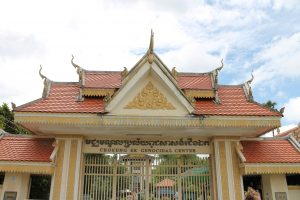
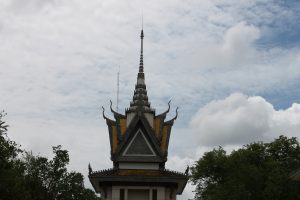
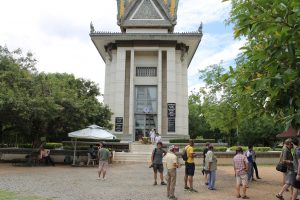
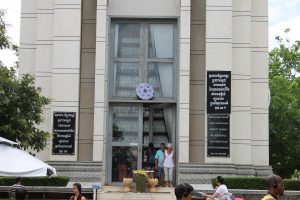
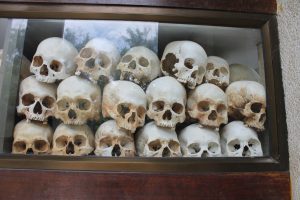
Upon arriving, the first thing you notice is an articulate archway, created in the traditional Cambodian fashion, as well as a tall building built with the same beautiful architecture, about 100 yards away from the entrance. After we walked inside the camp we dawned our headsets and began the audio tour. Another student on the trip, David, explained an interesting view of this after the tour stating that it felt odd to him that we had the privilege to listen at our own leisure and pace while we were walking on the souls of thousands. As we walked towards the first checkpoint, we grew nearer to the large ornate tower in the center. As we came closer the beauty of the architecture fades away as you notice the thousands of skulls and bones displayed inside; it was truly perturbing.

Entrance

tower in center

tower as we came closer

I won’t go into every detail of the audio tour, as it would take up too much time and my memory would not do it justice. As I began to walk around one of the things I noticed was birds singing and wildlife in full bloom. It was an oddly peaceful and almost tranquil place to be; almost as if it were a place to meditate and relax.


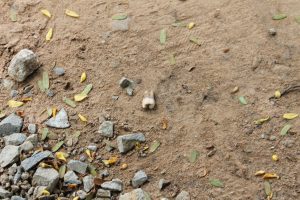
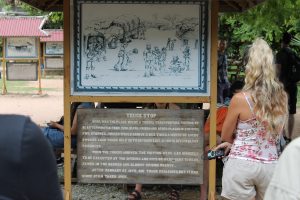
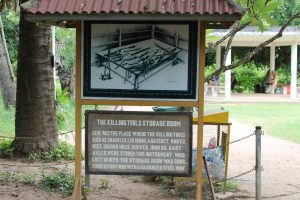
The path we walked and the audio tour portrayed a very different more terrifying realization. As you walk down the path there are sometimes fragments of bone and teeth scattered on the ground. There are dozens of pits and small mounds where mass graves had been excavated and the horrible reality hidden beneath brought into light for all to see. On the tour there were signs with descriptions of each area and recreated pictures of what the place was like while the killings were happening. Death and despair was everywhere and you could feel it.


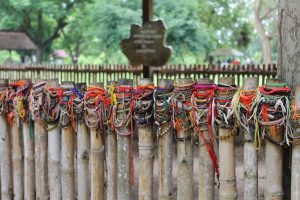
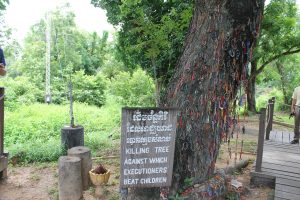
The mass graves have been decorated by tourists with bracelets as a sign of respect and sorrow for the victims, two places in particular had many bracelets; the mass grave of women and children and the child killing tree.


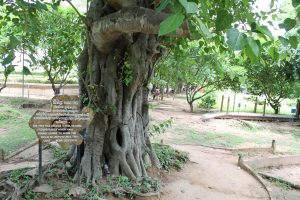
As the tour moves on. It brings you to a tree titled “The Magic Tree” that is explained to be the same species of tree under which Buddha found enlightenment. However this specific tree is ironically called this and was used to hang tools of massacre as well as lights and speakers that blasted revolutionary music to drown out the screams of agony. The audio tour provided a music clip of the music combined with a diesel generator recreating the noise the victims last heard. This was the hardest part of the tour for me and many others. The noise was terrifying and seemed to bring up the emotions of the anguished souls. There are no words to describe the feeling.

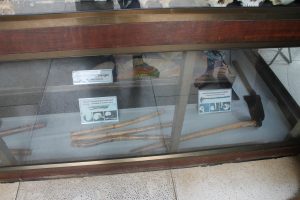
At the end of the tour we were allowed to visit inside the tower, I think it was called the Shtupa but don’t quote me on that. As we entered, we took off our shoes out of respect and were offered to buy incense or flowers to leave for the memorial. Inside the tower were many skulls and bones as well as the killing tools. Each skull had a different marking describing how they were killed.


This place is rough on the conscience and for religious people can be a place of questioning. If there is a God how could he let this happen? How can the world be so cruel if there is an almighty? Many people would answer different things, but none of them can take away the heaviness of the reality. After leaving this place I felt I will never be the same. It is hard to go on living the privileged way we do when you know there was and still is so much hardship for others. This place and this country makes me feel ashamed of my fortune and ashamed of my trivial worries. There is nothing left to do but give back as much as I can and try to better myself and the people around me one action at a time. Let this place be a reminder to all of the terrible possibility of genocide. It could happen anywhere, but when the time comes we must make an effort to prevent catastrophes like this to ever happen anywhere.
Mission to Cambodia: Freedom’s Promise School Clinic
Today (Thursday, 5/25) was the fourth day of our trip, but with travel was our second full day in Phnom Penh, Cambodia! After spending yesterday exploring the city and learning more about the history, we were going to engage in the community around us through a variety of ways. Following breakfast at the hotel, our group of fifteen split into three different groups. One group went with a Social Worker to do HIV home visits and another group went to a local hospital to assist with check-offs for their staff. The group I was with was six of us going to a local school through the organization Freedom’s Promise. At the school we would be holding a clinic for Well Child Checks.
As we arrived in the area with the school, the van dropped us off across the street and walked through a small street, similar to an alleyway. The bleak reality of these peoples’ living conditions shook me. Small rooms, which consisted of little more than dividing walls and a cover were homes for families. Running water and simply a place for trash were non-existent. After walking along the row of homes, we were then in the area with the school. It consisted of several classrooms, an office, and a library. A teacher directed us to their covered play area with tables and chairs to use for our clinic. Lauren and I, both nursing students, set up to do height, weight, vital signs, and an eye chart. The two Doctorate of Nursing students, Kim and Paige did thorough assessments. Dr. Wolford and Dr. Massie were assisting anywhere and everywhere – from aiding in assessments to helping prescribe to keeping kids entertained as they waited.
A health issue noticed in nearly every child was tooth decay. This may seem somewhat insignificant to us and an easy fix, but for these kids it can be so much more. If further decay occurs, they could end up without teeth or an infection. While the United States has fluorinated water to help prevent this, these children come from families without running water (and Cambodia’s water isn’t drinkable, much less fluorinated). For the most part, brushing their teeth isn’t a priority. A toothbrush here costs $1, which seems insignificant to us. Yet, for many of these families, that is a day’s wages – not to consider the need for toothpaste or the lack of access to clean water. This simple issue made me realize even further how we take so much for granted back at home.
Dr. Wolford, a pediatric nurse practitioner, made an important point at the beginning of the day. She said that “Kids were kids, wherever you go.” This simple statement eased some of the nerves about not speaking the same language, as I found this reminder to be so true. Smiles, laughter, and even many games are so universal. Even if it was after a little misunderstanding, we learned their games as they did cartwheels over a string made w
ith rubber bands. They learned limbo and we played their version of jump rope. As they waited for the next part of the assessment, Lauren and I were taught some of the shapes in Khmer. We sang “Head, Shoulder, Knees, and Toes” and taught some boys how to flip a half full water bottle to make it land correctly and cheered after many attempts for each of us. These kids were full of joy, despite their circumstances and I think that was the most powerful part of the entire experience.
Mission to Cambodia: First Day
Today was my first day in Cambodia. My group and I woke up early, had breakfast, and walked through the city to the river. Most notably it was hot, and I sweated a lot. The city was pretty and the people were nice, so that made the heat slightly more bearable. Later on in the day, I went with a group to visit the S-21 prison museum. S-21 was first a school before the Khmer Rouge took power. The Khmer soldiers decimated the school and turned it into one of many torture camps used by the Khmer Rouge during the Cambodian genocide. Their prisoners were held in hardly livable conditions, tortured daily, then killed slowly and painfully after they had given confessions to crimes they never committed. In each of the buildings, there were pictures of the prisoners and the cells they lived and died in. The whole experience was hard to swallow, but I forced myself to look at the pictures, the torture devices, and the bones of the prisoners. I forced myself because it’s easy to look away, to not think about it and forget it happened – especially to an American. However, I see it as the least I can do for the people who can’t look away, and who can’t forget no matter how hard they try. They people who died there had no rights, no freedom, and no say in what happened to them, but I believe they have a right to be remembered; and I believe that it is our duty to remember them and the injustice of the Khmer Rouge so that those injustices will not be repeated. I think S-21 is a perfect example of what the Khmer Rouge did to Cambodia: destroy education, replace it with misery and death, and then leave it to be forgotten. There was a monument constructed at S-21 declaring that the information there is the right and property of humanity as to not forget the cruelty we are capable of.
Pharmacy Student Named as Inaugural Thomas Hall Scholarship Recipient
Eva Kisakye, a student in Belmont’s College of Pharmacy, was recently named as an inaugural Thomas Hall Scholar through Child Family Health International (CFHI), an NGO focused on global health initiatives. Dr. Thomas Hall is a respected leader in global health, having worked for more than 60 years on improving the health of low-resource countries, providing medical care across the world and working to strengthen global health systems.
After a search that included nearly sixty applications, Kisakye was selected as one of the awards inaugural two recipients. A Ugandan native, Kisakye moved to the United States in 2008 to pursue her education. Passionate about community pharmacy, Kisakye will return to Uganda in October for a clinical rotation where she will work alongside mothers and children in an AIDS clinic, an opportunity she sought out and organized herself. The scholarship money will support Kisakye’s time in Uganda.
“I hope to become well-versed in ways to increase healthcare access in resource-limited settings while addressing healthcare disparities and social determinants,” Kisakye said. “Thanks again for giving me the opportunity to enhance my knowledge and clinical experience in public health while serving the people of Uganda.”
CFHI’s Executive Director said, Dr. Hall is a fearless advocate for the prominent position of young people in global health education, research, and practice. We are honored to support Dr. Hall’s vision and expand his impacts.
The recipients’ selection represents the end of a nationwide search for two future leaders in global health and a new step forward in Child Family Health International’s passion for training individuals in a setting that establishes industry standards in ethics and patient safety.
Mission to Guatemala: Last days
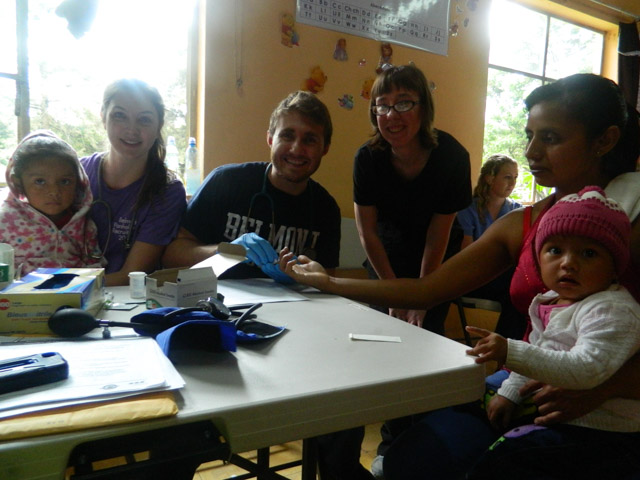
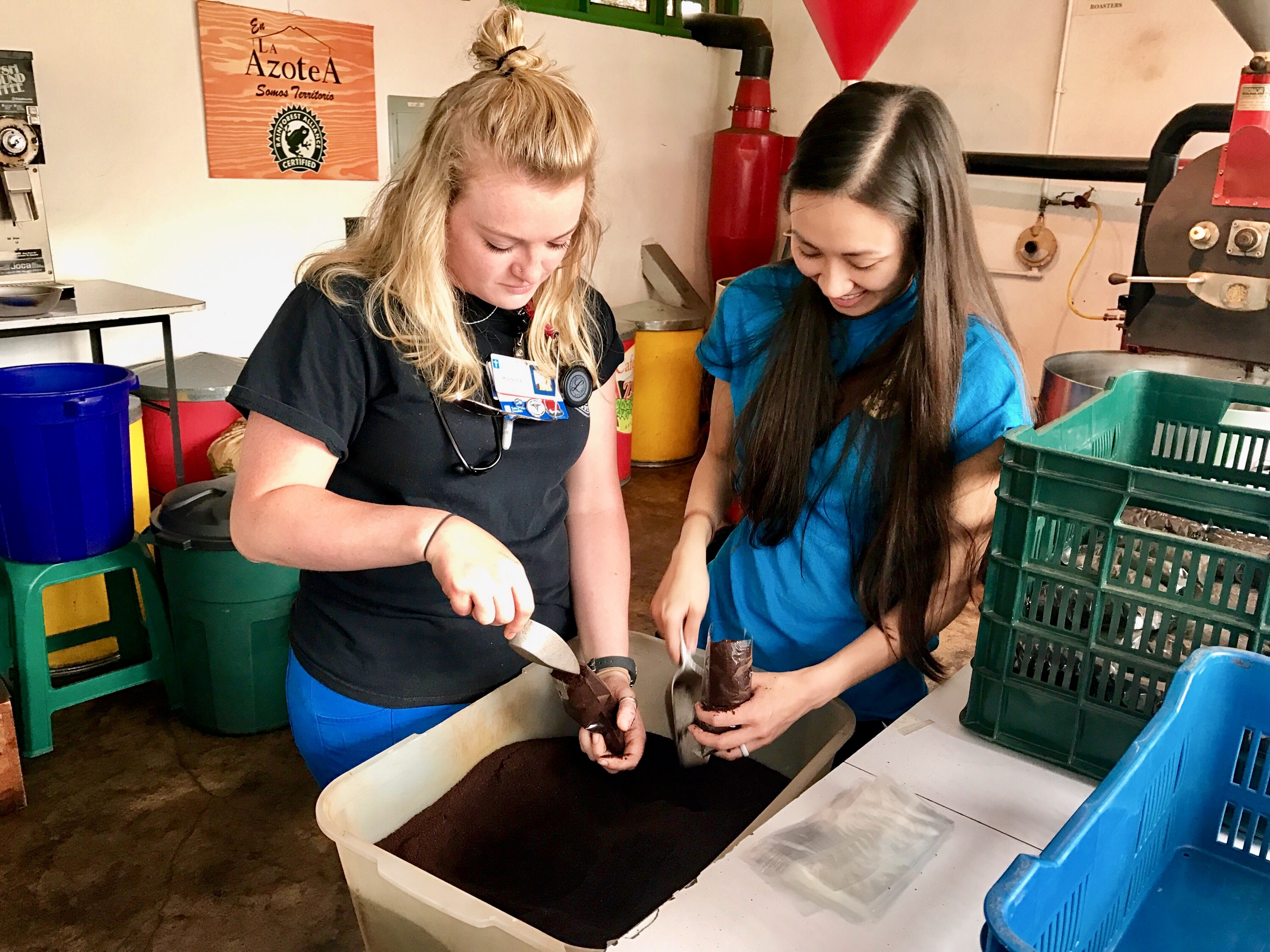
Today, the nursing/pharmacy team had the privilege of traveling to a prominent coffee plantation and offering a hand. We focused on providing health screenings and education to the plantation workers and their families. We were also able to hand out dental hygiene kits to all the individuals we crossed paths with. One thing that we have really learned on this trip is the value of teamwork. The nursing students, pharmacy students, and a Guatemalan doctor all worked hand in hand to provide this community with access to healthcare. We also got the opportunity to see how this plantation prepares their coffee products. Now not to brag, but if this healthcare stuff does not work out, some of us may have a future in the coffee industry. The highlight of our day was definitely towards the end. As we were passing the horse stables, we saw one of the young boys we had seen on day 1 of this trip. When we first saw him, he was the picture of discomfort and pain. Today, when we asked him how he was feeling, he responded with the biggest smile and an endless amount of gratitude. This was a reminder that all our hard work here was making a difference.
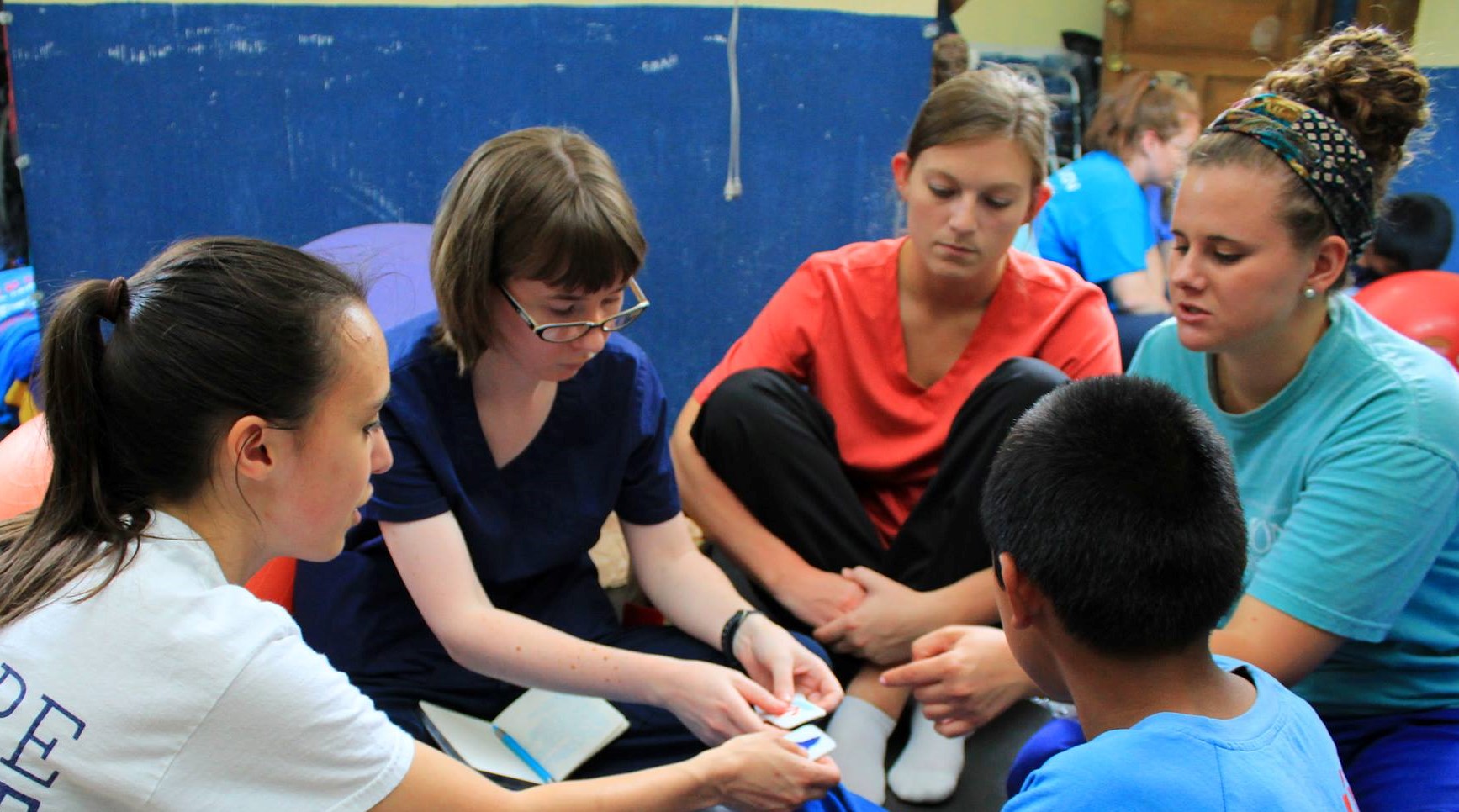
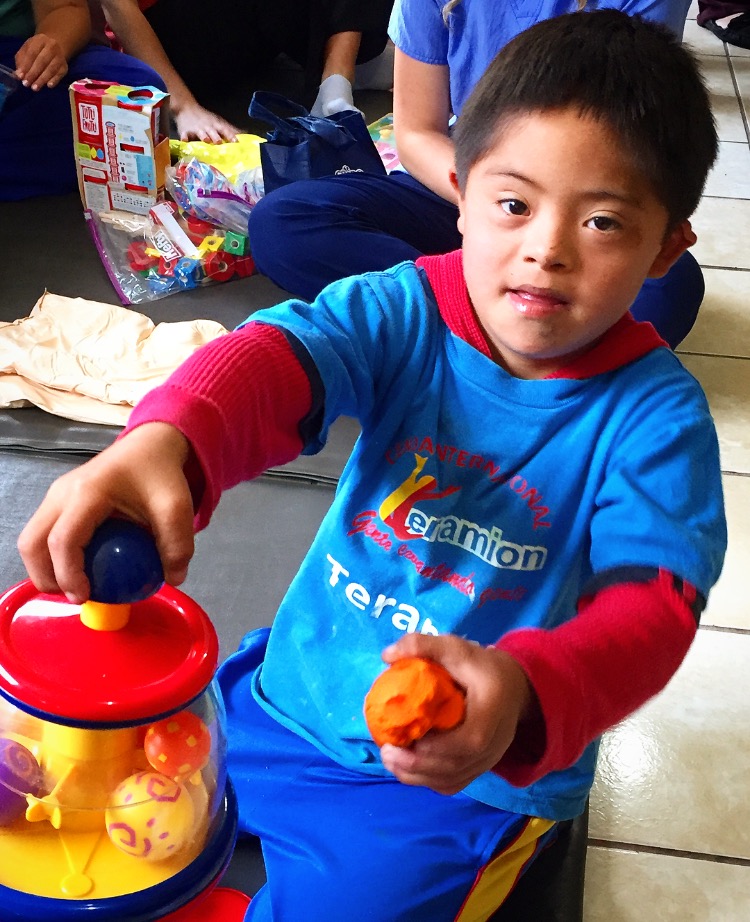
The PT/OT team spent our last workday back at Keramion, the school for special needs children that we visited on Monday. The day began with a bit of dancing, followed by receiving gifts from the children. We were so amazed by the generosity that we were shown and will treasure the gifts as well as the hugs we were given. Afterwards, the OT team saw one more child with autism who had some behavior issues that the mother and teachers wanted to discuss. We were able to provide education on different calming strategies such as deep pressure, bouncing on a ball, and slow swinging. His mom was present and was really interested in learning, and some of the other OT team members also had the chance to interact with child’s younger sister. Following this, the PT and OT students set up a small obstacle course for the children. Due to rain, we had to move it inside, but it still worked! The staff was excited to learn about new ways to engage the children in purposeful play that would encourage practicing different skills such as crawling, jumping, and grasping various objects.
The children headed home after completing the obstacle course so that the afternoon could be used for a staff in-service. Griselda, the school’s founder, also shared more of her incredible testimony with us, and we were able to pray for her which was a very moving experience for everyone involved. The PT students on the team also worked with Griselda on different exercises and were able to give her advice on managing her back pain. It was amazing to see how much she had improved in only a few days! For lunch, Belmont team members treated the staff to spaghetti, and the rest of the day was spent training the staff on specific topics such as sensory integration, proper lifting techniques, and behavior management. All of the staff members were extremely grateful for our help this week. After spending so much time together, it was hard to say goodbye, but we know that the children are in good
hands at Keramion and that God is definitely at work there. It was such a blessing to bear witness to this incredible ministry this week.
Written by: Anais, Emily, Alicia, and Hope
Mission to Guatemala: Mother’s Day
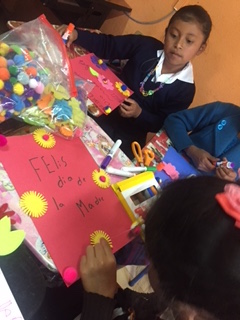
Today was Mother’s Day which is a major holiday in Guatemala as many of the mothers had the day off work. We wanted to help serve the community by helping them prepare for the special celebration. We enjoyed helping the students decorate and pick flowers from the field for the mothers. The PT/OT team also supported the nursing and pharmacy students stepping in as needed to assist with orthopedic and musculoskeletal concerns. We worked as a team to identify the proper professional needed for each case. The PT/OT team also spent the afternoon preparing educational materials for the upcoming day tomorrow.
Today, the nursing team primarily focused on mothers and children, with cultural perspective seeming to be the theme of the day. Because there was such a high number of mothers and children seen there were several things that we realized that we never noticed before. One was the relative age of mothers. Today we had a mother who was 19 with two children. This provided a dose of perspective as several members on the team are around this age and could not even imagine being in her shoes. It was also shocking to realize how access to care differs from America. Back home, if we have a concern with a child we can just drive to a clinic; however, here in Guatemala mothers showed up from all around carrying babies on their backs knowing that we were the only resources they had access to. It was eye-opening and humbling to see how far these women came just for us to get the opportunity to care for them.
Written by: Kristin & Dylan from nursing and Lexi & Maggie from PT/OT
Mission to Guatemala: Teamwork
TEAMWORK was the word of the day. Today both the OT/PT and Nursing/Pharmacy teams went to a coffee plantation with a school attached. Nursing and Pharmacy set up a health screening station similar to yesterday where they checked blood pressure, blood glucose, and height/weight. We assessed their needs for any medications and the doctor was able to write prescriptions. For example, one coffee worker came in for a screening and stated there were no complaints. When the nursing team found out he was having knee pain, the physical therapists were brought in to show him exercises for strengthening and explain why those would be beneficial. He was very grateful because he could apply what he learned to his everyday work. In addition, while performing a health screening on a mom and her son, nursing noticed that the son was having difficulty with using his hands. Occupational therapy was brought in to do a short assessment with the son and he was given a bag of toys to take home with him to work on his fine motor skills and radial-ulnar dissociation. He was overjoyed and thankful for the toys that he could call his own.
The kids at the school were preparing for Mother’s Day tomorrow, which is a huge holiday here and the kids were excited to make crafts for their “madre”. The kids split into groups and made necklaces bracelets with beads and a card with flowers and a special message to their mom. After this activity, the kids were excited to play outside with jump ropes, soccer and parachutes. The team noticed how much joy and happiness the kids had on their faces and in turn how much joy and happiness they brought to each one of us.
Even though there was a language barrier, the interpreters were very helpful and greatly appreciated. While there was difficulty finding interpreters who were willing to take off work from their daily jobs to help, there were a few who were gracious enough to fill the need. Along with an interpreter, a few people on the team taught CPR for adults and infants as well as the Heimlich maneuver to the adults and high school students. The parents were grateful for this education and were able to practice on the mannequin.
As we performed screenings, played outside with the kids, and did arts and crafts, every one of us on the team was amazed by the joy and love we received from them. Our work is truly appreciated and we can’t wait to go back again tomorrow to help celebrate Mother’s Day!!!


Adios for today from Guatemala!
Maria (PT), Hope (OT) and Allison (Nursing)
Mission to Guatemala: Our first day
Buenas Noches!! We successfully completed our first day of clinics here in Antigua, and wow was it humbling. The nursing/pharmacy students had the privilege of caring for around 50 students at a local school on a coffee plantation here in town. We set up a pop-up clinic that assisted a Guatemalan doctor providing physicals and basic health screenings for children and their mothers. Although today might not have gone according to our “perfect” schedule, we used today as a learning experience to remind ourselves that God’s perfect plan does not always align with our ideal plan. As a team, we learned that even though our treatment plans may have felt insufficient to the need we were trying to fulfill at the time, our love was sufficient and the Lord’s presence was there. A team member, while providing care, saw this first hand. She was observing a student who was young and just appeared sad and scared. She noticed that the student had been looking at her stethoscope with curiosity so she went and asked if the student would like to listen to her heart. The second the student began to listen her whole demeanor began to change. Her face lit up and she said “Corizone boom boom”. She continued to listen to other body sounds smiling the entire way. Through this encounter, it became apparent that healing is not only physical, it is more so emotional and spiritual, and although we do not have the resources to heal every single medical issue, we do have the capacity to show love and heal spiritually and that is in some cases even more valuable than fixing a physical issue.
At the same time, the physical therapy and occupational therapy team was over at the school for disabled children called Keramion. We started off getting to learn a lot about the school and the teachers that are devoting their lives to help these children. This staff was incredible and so welcoming of the team. Everyone was greeted with a big hug and a such a genuine smile! Griselda, the founder of the school, was so open in telling us her testimony and all she’s gone through to make Keramion an awesome environment for these kids to learn and grow. After meeting the kids, the team split up according to their specific needs and evaluated each child to assess where they are in their development. The staff members were very grateful for ideas that the mission team had given them on past trips and we’re hoping to give them more suggestions to continue the progress they are already making! While a lot of our day consisted of evaluating and utilizing what we have learned in school, a great portion of the day involved playing, interacting, and loving on the kids. A definite highlight of the day was coming back from lunch to everyone singing, dancing, and praising Jesus. We had so much fun brainstorming games for the kids to play that will also help their therapy progress! After all the thanks we received, we couldn’t help but feel equally blessed by the staff and kids of Keramion and we are so excited to go back on Thursday!
Adios from Guatemala!
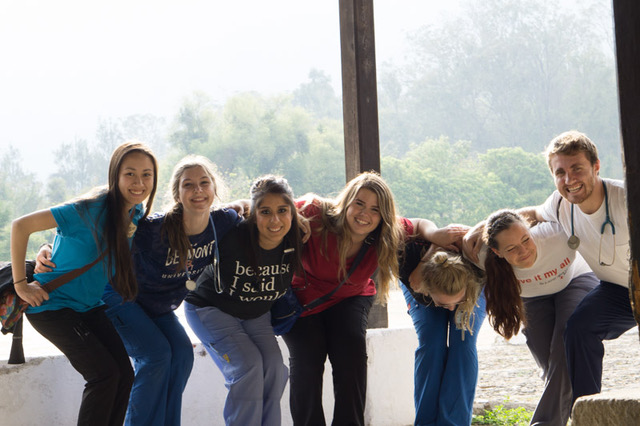
Kendall & Macey from PT (in the picture below), Kristin (not pictured) & Brooke ( back row right in the picture above) from nursing
Tennessee Health Care Hall of Fame Announces 2017 Inductees
Hall of Fame’s third class represents Tennessee’s greatest health and health care pioneers
With a mission to honor men and women who have made significant and lasting contributions to the health and health care industries, the Tennessee Health Care Hall of Fame announced the six health care professionals selected as the Hall of Fame’s 2017 class at a luncheon on Belmont University’s campus today. Created by Belmont University, the McWhorter Society and Founding Partner the Nashville Health Care Council, the Hall of Fame will induct these individuals at a ceremony in October.
President of the Nashville Health Care Council Hayley Hovious said, “This impressive group of inductees represents some of our state’s greatest talent. With individuals from all across Tennessee who have made a significant impact on their communities through their work as leaders, politicians, practitioners, scientists, philanthropists and innovators, the Hall of Fame is honored to induct such a deserving group of health care heroes.”
The nomination process began in January and was open to practitioners, executives, entrepreneurs, mentors, teachers, scientists, researchers, innovators or any person with a connection to the health or health care field. Nominees must have:
- Been born, lived or have worked in Tennessee
- Made a significant impact and lasting contribution to health care at the local, state, national or international level
- Exhibit the highest ethical and professional character
- Serve as an outstanding role model in their community
Among the more than 30 highly qualified nominees, inductees were chosen by a Selection Committee made up of health and health care leaders from across the state. Selected inductees represent some of Tennessee’s greatest health and health care pioneers, leaders and innovators.
The 2017 inductees include:
- Dr. Dorothy Lavinia Brown: First African American female surgeon in the south, TN House of Representative and General Assembly Member, Longtime educator and Chief of Surgery at Riverside Hospital and Clinical Professor of Surgery at Meharry, Advocate for women’s health, rights and education
- Dr. William “Bill” Frist: Former U.S. Senator and Majority Leader, Vanderbilt Transplant Center founder, First heart and lung transplant surgeon at Vanderbilt, Founder of Hope Through Healing Hands and NashvilleHealth, Senior Fellow at the Bipartisan Policy Center
- Joel Gordon: 47-year health care veteran who introduced physician ownership/joint ventures as a business structure, Founder of GeneralCare and Surgical Care Associates, Co-Founder of HealthWise of America, Owner of Gordon Group Investment Management
- Dr. Harry Jacobson: Physician, entrepreneur and investor who founded/co-founded eight companies, Past Chair of the Nashville Health Care Council Board of Director, Executive-in-Residence at Belmont University’s Jack C. Massey College of Business, Past Vice Chancellor for Health Affairs at Vanderbilt University and former CEO of Vanderbilt University Medical Center
- Dr. Stanford Moore: Received the Nobel Prize for Chemistry in 1972 for his work with proteins and their composition which led to the first understanding of the complete chemical structure of protein and ultimately informed decades of scientific work surrounding disease and drug discovery; Graduate of the University School of Nashville and Vanderbilt University
- Dr. Donald Pinkel: First Director and CEO of St. Jude Children’s Research Hospital; Received the Lasker Award for Medical Research, Kettering Prize for Cancer Research and Pollin Prize for Pediatric Research; Led the development of the first treatment for childhood acute lymphoblastic leukemia, increasing the cure rate from 4 to 50%.
In addition to recognizing Tennessee’s most influential health and health care leaders, The Hall of Fame will serve as an on-going educational resource to document the rich history that has contributed to Tennessee’s position as a leader for national health care initiatives.
Belmont’s President Dr. Bob Fisher said, “One of the things I am incredibly grateful for is Belmont’s placement in Tennessee – a state that is widely recognized as a central hub for health care in the United States, with Nashville at the helm. Our community continues to see the efforts of so many as individuals and organizations take significant strides towards shaping and advancing the health and health care industries. Meanwhile, Belmont continues to play an increasingly significant role in undergraduate, graduate and executive health care education. The induction of these six health care legends, and those that will come after them, will help Belmont inspire the next generation of health care greats, while further promoting our state’s booming success as the nation’s premiere health care hub.”
Created in 2015, the Hall of Fame has previously inducted 14 members including Jack Bovender, Dr. Stanley Cohen, Dr. Colleen Conway-Welch, Dr. Thomas Frist, Jr., Dr. Thomas Frist, Sr., Dr. Henry Foster, Dr. Ernest Goodpasture, Dr. Frank Groner, Jack C. Massey, R. Clayton McWhorter, Dr. David Satcher, Dr. Mildred Stahlman, Dr. Paul Stanton and Danny Thomas.
Recent Social Work Graduate Pays It Forward at Kipp Academy in Nashville

Cherish Woodard, a May 2016 Belmont social work graduate and fifth grade English Language Arts Teacher at KIPP Academy Nashville, was recently featured in an article published by KIPP:Nashville, a network of public charter schools in the Nashville area. Entitled “Paying It Forward,” Woodard’s feature details her own story — and how, as a child, she found herself experiencing homelessness due to an electrical fire. Forced to split her family up, Woodard and her relatives were dispersed all throughout Nashville.
“I went from seeing my family every day to every now and then. But the experience did give me a unique perspective on life, and it’s something I draw on while I’m in the classroom,” Woodard is quoting as saying. Relocating to East Nashville, Woodard begin building a community in the same place she now teaches. After graduating high school, Woodard went on to attend Belmont, earning a scholarship that supported her tuition.
At first, Woodard said she was interested in studying business, but when she found social work, she knew she’d discovered her calling. “Social work not only helped me better understand people in general, it helped me understand my family and our dynamics better. I use that knowledge every day with my students,” she said.
The article goes on to describe Woodard’s passion in the classroom, detailing the ways she connects with students, her commitment to their success and her engaging energy. Woodard sees her time as an educator as an opportunity to impact a child’s future. Understanding the challenges that her students are facing, she is able to create an environment where they are safe, loved and secure. “I know what it’s like to make difficult choices and sacrifice for what you want…I always say, ‘You’ve got to learn to live in the world and then change it’!”
As for her philosophy for teaching, Woodard said, “Seed planting is important. As long as the seed continues to get nurtured, it will grow. Although I may not be the one who’s able to continue nurturing the seed, I pray there will be others.”
School of Nursing Ranked Among Best Graduate Programs by U.S. News & World Report
Belmont University’s graduate nursing programs were lauded today when U.S. News and World Report released its 2018 rankings of Best Graduate Schools, a tool to help prospective graduate students better understand the graduate school landscape and identify potential programs. Both the Master’s in Nursing (No. 157) and the University’s Doctor of Nursing Practice (No. 127) were included in this year’s rankings which surveyed 532 accredited nursing schools.
Belmont College of Health Sciences and Nursing Dean Dr. Cathy Taylor said, “We’re pleased with this recognition for our growing graduate and doctoral nursing programs and the extraordinary strengths our faculty bring to teaching and practice every day.”
Both the master’s and DNP rankings are based on a weighted average of 14 indicators. Seven ranking indicators are used in both the master’s and DNP ranking models. The seven common factors are the four research activity indicators, faculty credentials, the percentage of faculty members with important achievements and faculty participation in nursing practice. The other seven indicators in each ranking use measures that are specific to each degree type. Both rankings take into account the ratings of academic experts.
Belmont graduate family nurse practitioners (FNPs) are prepared to practice in a variety of settings. Graduates are particularly skilled in measurement of patient and population outcomes, education of diverse populations, leadership in health policy development and implementation, translation of evidence into clinical practice and advocacy for quality care within complex health care delivery systems. This is directly reflected in Belmont’s consistent 100 percent national certification examination pass rate and robust, post-graduation job placements.
Belmont’s other health science-focused programs were lauded among U.S. News 2017 rankings—the website doesn’t rank those programs on an annual basis. For 2017, Belmont’s pharmacy (No. 98), occupational therapy (No. 88) and physical therapy (No. 79) programs were all included in the national rankings of Best Graduate Schools.
Social Work Club Hosts Nashville Unity Project
Beginning on April 6 and lasting through April 9, Belmont University’s Social Work Club organized and implemented an interactive art project in Nashville as part of the international Unity Project movement. The event was aimed at reducing division in the community by visually showing how all lives are interconnected and related.
The event was held at the Bellevue Branch of the Nashville Public Library and began with an opening ceremony that featured a panel discussion led by local community members on matters of diversity and inclusion. Panelists included Belmont’s Chief of Staff and Vice President Dr. Susan West, Vice Chancellor for Equity, Diversity and Inclusion at Vanderbilt Dr. George Hill, Education and Street Chaplaincy Coordinator for Open Table Nashville Lindsey Krinks, Community Relations Manager at Tennessee Immigrant and Refugee Rights Coalition Leah Hashinger, Belmont student Jasmine Niazi and a representative from Conexión Américas.
After the opening ceremony, the interactive art project was open for public participation during normal library hours and was constantly supervised by Belmont students until the closing ceremony, held on April 9. The art project consisted of 32 poles placed in a circle, with each pole representing a unique identifier (culture, ethnicity, race, religion, etc.). Participants were invited to wrap colorful yarn around the poles they identified with, connecting themselves with the growing piece. Once complete, the yarn formed a cohesive web of interconnectedness to show that community members have more similarities than they do differences. The closing ceremony featured a poetry reading, music by a local artist and a group discussion on diversity, which was led by Associate Professor of Social Work Julie Hunt.
Belmont student Kate Patterson initially came up with the idea to bring the Unity Project to Nashville after being inspired by her participation in a Unity Project in Washington D.C. last June. Patterson was the main student involved in organizing the event and was present throughout the whole event.
“The Social Work club and I have been working out the details for the event for several months. It was rewarding to see the event take place after so muc
h planning,” Patterson said. “The panel discussion at the opening event was powerful to hear how organizations across Nashville value working together with various populations for a common goal of promoting the rights of humans. Throughout the weekend, I was blessed to meet many amazing individuals who reflected on their identities and had dreams of carrying the event to other locations around Nashville and to other cities. It was refreshing to meet so many people who worked together to create unity in the collaborative art piece as well as in their lives.”
The Unity Project was created in June of 2016 as a response to the divisiveness and negative rhetoric in American politics. Since its conception, the Unity Project has been completed in more than 20 countries.
Students and Faculty Attend Nashville Health Care Council’s DC Delegation
Five students and one associate professor from the Belmont University recently attended the Nashville Health Care Council’s Leadership Health Care (LHC) initiative, along with a group of more than 100 health care leaders, on its annual two-day delegation to Washington, D.C. This year’s event provided delegates with an inside look at the state of health care policy under the new administration and predictions about what developments may unfold to impact Nashville’s $78 billion health care industry.
The delegation featured discussions with members of Congress such as U.S. Representative Diane Black (R-TN) and U.S. Representative Jim Cooper (D-TN). The other key health care leaders who participated in discussion panels were Jay Perron the Vice President of America’s Health Insurance Plans, Chip Kahn the President and CEO of the Federation of American Hospitals, and Michael Ramlet, the Founder and CEO of the Morning Consult.
Pictured above: L to r: Brittani Montgomery, PharmD Student, Bruce Alter, DPT Student, Drew Dudek, DPT Student, Sabrina Salvant, OTD Faculty Member, Kerry Ternes, BSN-DNP Student, and Julie Wofford, OTD Student
Hallmark Elected to INACSL Nominations and Elections Committee
Assistant Professor in Belmont’s School of Nursing and Director of College and Health Sciences Simulation Dr. Beth Hallmark was recently elected to the Nominations and Elections Committee for the International Association of Clinical Simulation Learning (INACSL). The INACSL is a portal for nurses and educators dedicated to advancing the science of health care simulation by developing standards for its practice. Hallmark will join four other committee members for a two-year term of service, beginning in 2017 and continuing through 2019.In addition to her recent achievement, Hallmark has been serving as an invited contributor for the National League of Nursing’s (NLN) TEQ blog. Sponsored by the NLN Center for Innovation in Simulation and Technology, the blog works to keep nurse educators up-to-date with the latest innovations in simulation, e-learning, telehealth and informatics. Hallmark is on the blog’s editorial advisory board, which oversees content and contributes articles while also interacting with followers. The team is comprised of nurse educators who have been actively involved with the NLN’s technology-related professional development programs and are experts in the field.